
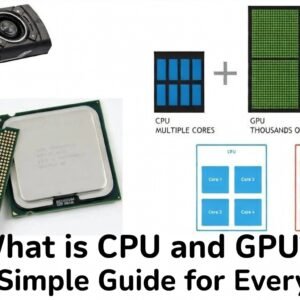
When you look at a computer, two of the most important parts inside are the CPU and the GPU. You have probably heard these words before. But what is CPU and GPU really? Think of your computer like a busy office. The CPU, or Central Processing Unit, is the office manager. It makes all the big decisions and handles many different tasks, one after the other. The GPU, or Graphics Processing Unit, is like a huge team of artists. They all work together at the same time to draw complex pictures, like in a video game or a movie. This is the main difference between a CPU and GPU. The CPU is great at quick, single tasks, while the GPU is a master at doing thousands of simple tasks all at once. This teamwork is what makes everything on your screen happen, from typing a document to playing the latest game. Understanding the CPU and GPU meaning is key to knowing how your tech works.
The Heart of Your Computer: What is a CPU?
The CPU is the main brain of your computer. It sits on the motherboard, which is the big circuit board that connects everything. Every single thing you ask your computer to do goes through the CPU first.
The job of the CPU is to follow instructions from computer programs. It does calculations, makes logical decisions, and tells all the other parts what to do. Whether you are browsing the web, writing an email, or editing a spreadsheet, the CPU is in charge of making it happen.
Think about the office manager again. They open mail, answer phone calls, talk to clients, and organize files. They can only do one of these things at a time, but they can switch between them very, very quickly. This is what your CPU does. It handles tasks serially, meaning one after another, but at lightning speed. This is a core part of the CPU and GPU meaning. The CPU is the ultimate generalist.
How a CPU Works: Cores and Clocks
A modern CPU has several parts inside it that help it work fast:
-
Cores: Think of a core as a mini-CPU inside the main CPU. Old computers had just one core. Now, most have 4, 6, 8, or even more. More cores let the CPU handle more tasks at the same time, like having multiple office managers.
-
Clock Speed: This is measured in Gigahertz (GHz). It tells you how many cycles, or tiny tasks, the CPU can do in one second. A higher GHz often means a faster CPU.
-
Cache: This is the CPU’s own super-fast memory. It stores data the CPU uses a lot so it doesn’t have to wait to get it from the slower main memory (RAM).
The Graphics Powerhouse: What is a GPU?
So, what is a GPU? The GPU is a special kind of brain built for one main job: handling graphics and complex math. While the CPU is a specialist in doing a few complex tasks quickly, the GPU is a master of doing thousands of simple tasks all at the same time. This is called parallel processing.
Going back to our office, the GPU is the big team of artists. To draw a huge, detailed poster, one artist would take forever. But if you have 100 artists, each drawing a small part, the poster gets done in no time. This is exactly how a GPU works when creating the images for your screen.
Every pixel on your monitor needs color and light information. A modern screen has millions of pixels, and they need to be updated 60 or more times every second for smooth motion! The GPU is built to handle this massive job perfectly. It has hundreds or thousands of smaller, simpler cores designed to work together on this single type of problem.
The Two Types of GPUs
-
Integrated GPU: This GPU is built right into the same chip as the CPU. It shares the computer’s main memory (RAM). It’s good for everyday tasks like watching videos, basic office work, and simple games. It’s power-efficient and keeps costs down.
-
Dedicated (Discrete) GPU: This is a separate, powerful card that plugs into the motherboard. It has its own dedicated memory (called VRAM) and cooling system. A dedicated GPU is essential for demanding tasks like graphics processing for modern video games, 3D animation, video editing, and scientific simulations. It’s a key component in understanding the difference between a CPU and GPU in terms of power and specialization.
CPU vs. GPU: What’s the Big Difference?
Now that we know what is CPU and GPU, let’s compare them directly. The main difference between a CPU and GPU is how they are designed to think.
| Feature | CPU (Central Processing Unit) | GPU (Graphics Processing Unit) |
|---|---|---|
| Main Job | The computer’s general-purpose brain. Handles all system tasks and logic. | A specialized brain for rendering graphics and parallel calculations. |
| Work Style | Serial Processing. Excels at doing one or a few complex tasks very fast. | Parallel Processing. Excels at doing thousands of simple tasks simultaneously. |
| Cores | Fewer cores (e.g., 4-16), but each is very powerful and smart. | Hundreds or thousands of smaller, simpler cores designed to work together. |
| Ideal For | Running the operating system, applications, web browsing, calculations, file management. | Rendering video game graphics, video editing/encoding, 3D modeling, AI and machine learning. |
| Analogy | A skilled office manager who handles diverse tasks one by one. | A massive team of artists all painting different parts of the same mural at once. |
Working Together: The Perfect Team
The CPU and GPU don’t work alone. They are a team. In a video game, for example:
-
The CPU does the “game logic.” It calculates where your character is, if an enemy sees you, what your score is, and what should happen next in the story.
-
The CPU then sends instructions to the GPU.
-
The GPU takes that information and works its magic. It calculates the lighting, shadows, textures, and colors for every single object and pixel you see on the screen, creating the final image. It does this for every frame, 60 or more times a second!
You can learn more about how to monitor their performance and health by checking out our guide on how to check CPU temperature. Keeping an eye on temperature is crucial, and you can find out the optimal CPU and GPU temperature for safe operation. For a deeper technical dive into their architectural differences, this comparison of GPUs and CPUs is an excellent resource.
Where Do We See CPUs and GPUs Today?
You now understand what is CPU and GPU. But they are not just in your laptop.
-
Smartphones: They have tiny, powerful CPU and GPU chips (often combined into one “System on a Chip”) to run apps, games, and cameras.
-
Game Consoles: Devices like the PlayStation and Xbox have both a strong CPU and a very powerful custom GPU to deliver amazing graphics.
-
Supercomputers & Data Centers: Scientists use thousands of GPUs linked together. Why? Because GPUs are incredible at the math needed for weather forecasting, medical research, and artificial intelligence (AI). AI programs like ChatGPT were trained on farms of powerful GPUs.
-
Cryptocurrency Mining: Miners once used many GPUs because they were great at solving the specific math problems needed to mine digital coins.
Choosing the Right Tool for the Job
So, what is CPU and GPU best for? The choice depends on your task.
-
You need a strong CPU if: You do a lot of tasks at once (like having 20 browser tabs open while streaming music), you work with large spreadsheets, you program code, or you use software that relies on single-threaded performance.
-
You need a strong GPU if: You play modern 3D video games, you edit high-resolution video or photos, you create 3D models and animations, or you work with AI and machine learning tools.
For most people, a balanced computer with a decent CPU and a good integrated GPU is perfect for everyday use. Gamers, creators, and professionals will want a computer with both a powerful CPU and a dedicated GPU card.
Conclusion: Two Brains Are Better Than One
In the end, asking “what is CPU and GPU?” is like asking about the difference between a brilliant manager and an entire factory crew. Your CPU is the versatile, decision-making manager that runs the whole show. Your GPU is the massively parallel crew that specializes in creating stunning visuals and crushing specific types of math problems. They are designed differently because they have different jobs. The CPU handles complexity with speed, while the GPU handles volume with parallel power. Together, they make our digital world possible, from the simplest text document to the most immersive virtual reality experience. Now that you know the difference between a CPU and GPU, which one do you think has had a bigger impact on the latest tech you use every day?
References & Further Learning:
-
How to Check CPU Temperature: A practical guide for monitoring your hardware’s health. https://www.businesstomark.com/how-to-check-cpu-temp/
-
Optimal CPU and GPU Temperatures: Understand the safe operating ranges for your components. https://directmacro.com/blog/post/what-is-optimal-cpu-and-gpu-temp
-
AWS Comparison: The Difference Between GPUs and CPUs: A technical overview from a cloud computing perspective. https://aws.amazon.com/compare/the-difference-between-gpus-cpus/
-
For more insights on technology and business tools, visit Biz Reporterz.