
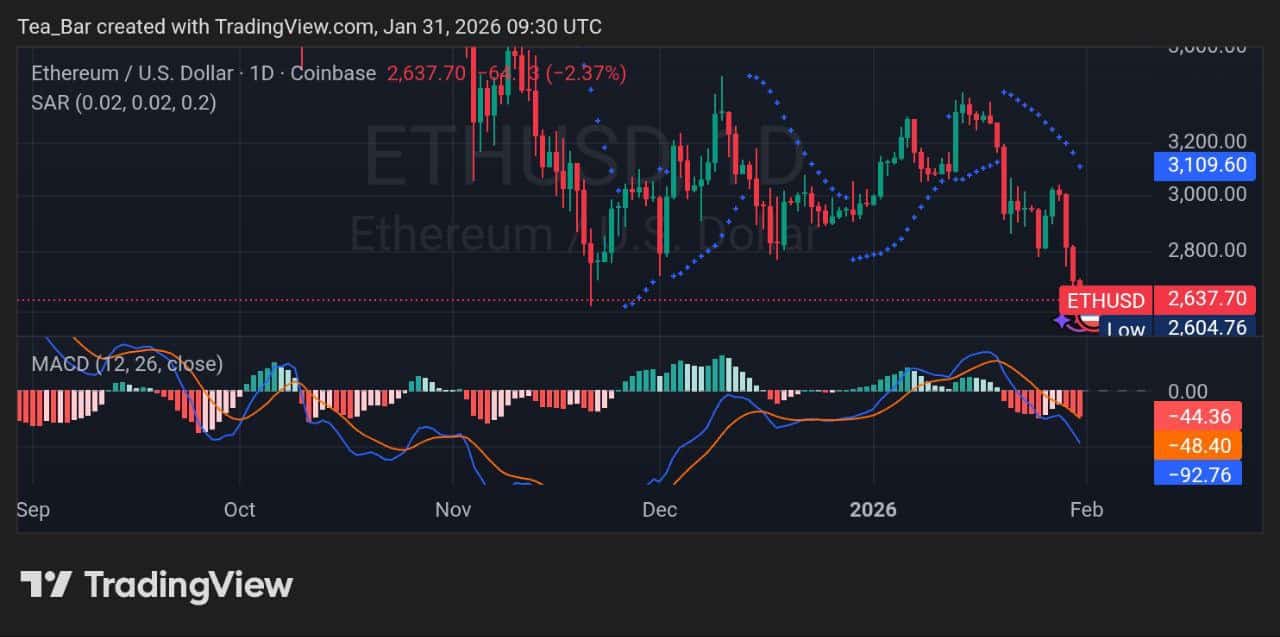
Ethereum faces sharp challenges in early 2026. Ethereum market trends show big price drops and heavy selling pressure. As of February 1, 2026, ETH trades around $2,300 to $2,440, down over 8-10% in the last 24 hours. This follows a broader crypto sell-off. Liquidations hit hard, with over $1.15 billion in ETH positions wiped out in a day. Total crypto liquidations topped $2.5 billion. One trader lost $220 million on a single leveraged ETH position. These Ethereum market trends reflect risk-off moves, ETF outflows, and macro worries.
Current Price Action and Key Drops
ETH plunged below $2,300 at times today. It fell as much as 17% in 24 hours during thin trading. This matches Bitcoin’s slide but hits ETH harder. Prices tested lows near $2,300-USDT on exchanges like Binance. From recent highs, ETH lost significant ground. It sits well below $3,000, with some reports noting drops under that level due to events like the U.S. government shutdown.
Main drivers of the drop:
- Leverage wipeouts — Massive liquidations sped up the fall.
- Thin liquidity — Weekend and low-volume trading made moves bigger.
- Broader market fear — Crypto lags behind rallies in gold and stocks.
- Institutional exits — Heavy selling from big players.
Experts note this as a test phase. Past cycles show ETH recovers after sharp corrections. Bulls defend key zones like the 200-week moving average around $2,400. If support holds, a bounce to $2,685 could happen in days, per some predictions.
ETF Outflows Weigh on Ethereum Market Trends
Spot Ethereum ETFs see big redemptions. This week, net outflows reached $327 million. BlackRock’s ETHA led with $264 million out. Grayscale’s ETHE added $27.6 million in exits. Cumulative flows turned negative in recent periods. One day alone saw $155.6 million leave U.S.-listed ETH ETFs.
Why the outflows?
- Risk aversion — Investors shift to safer assets amid volatility.
- Price pressure — Falling ETH scares off new money.
- Coordinated selling — Major providers redeem shares.
Total ETH ETF assets sit around $15-16 billion. Historical net inflows reached $11-12 billion, but 2026 started weak. Some days show small inflows, like $117 million breaking outflow streaks earlier. Still, the trend adds downward pressure on Ethereum market trends.
For investors, watch ETF data closely. Positive flows often signal conviction returns.
Liquidations and Leverage Impact
Leverage played a big role. A single $220 million ETH liquidation on Hyperliquid triggered chain reactions. ETH led with $1.15 billion in wiped positions. This pushed total crypto liquidations past $2.5 billion. Long positions got hit hard in the slide.
This shows risks of high leverage in volatile times. Many traders faced forced sells. It created a feedback loop: price drops trigger more liquidations, which push prices lower.
Tips to avoid this:
- Use low or no leverage — Stick to spot holdings for safety.
- Set stop-losses wisely — But avoid tight ones in thin markets.
- Monitor open interest — High levels warn of potential cascades.
- Diversify — Don’t put everything in leveraged ETH plays.
These steps help navigate rough Ethereum market trends.
Institutional Moves and Whale Activity
Some big holders add ETH despite drops. BitMine (linked to Tom Lee) bought 40,302 ETH, pushing its stack to 4.24 million ETH. But now it faces over $6 billion in unrealized losses as prices fell. This shows mixed signals: conviction from some, pain from timing.
Other notes:
- Smart money sometimes buys dips.
- Whales face big paper losses but hold long-term.
- Institutions cut exposure overall.
This creates uncertainty in Ethereum market trends. Watch for more corporate buys as signs of bottom interest.
Technical Outlook and Predictions
ETH tests key supports. It nears $2,100-$2,000 if bears win. Bulls eye bounces from high-volume zones. Some forecasts see $2,685 by early February (up ~10%). Longer-term, 2026 averages hover around $4,600-$5,200, with highs possible near $5,200+.
Prediction market odds favor ranges like $3,400-$3,600 for February highs, but low probabilities for big jumps. Sentiment stays bearish short-term. Oversold signals hint at relief rallies.
Broader Developments in Ethereum
Positive news exists amid the dip. The Ethereum Foundation prioritizes post-quantum security. It formed a dedicated team for leanVM and PQ signatures. This prepares for future quantum threats. Vitalik Buterin withdrew ETH worth $43 million for open-source security projects.
BlackRock views ETH as a key beneficiary of stablecoin growth and tokenization. This points to real-world use cases strengthening over time.
These long-term steps reassure holders. Ethereum market trends may shift as adoption grows.
FAQs on Ethereum Market Trends
Why is ETH dropping so much right now? Heavy liquidations, ETF outflows, and macro risks drive the sell-off.
Are Ethereum ETFs still seeing inflows? Mostly outflows recently, but some days flip positive.
What price could ETH hit soon? Short-term predictions range from $2,100 lows to $2,685 bounces.
Is now a good time to buy ETH? Dips attract long-term buyers, but wait for stabilization.
Where to follow updates? Check CoinDesk or Bitcoin.com News for daily insights.
Conclusion
Ethereum market trends highlight volatility in early 2026. Sharp drops, big liquidations, and ETF outflows create tough conditions. Yet, technical supports hold, and long-term factors like security upgrades and institutional views offer hope. ETH could rebound if macro calms and flows turn positive. Stay informed and invest carefully.
What do you think—will ETH bounce back soon or test lower levels? Share below.
References:
- Bloomberg Crypto — Real-time prices, charts, and analysis for crypto investors tracking market moves.
- Bitcoin.com News — Daily updates on ETH developments, whale moves, and tech advancements for enthusiasts.
- CoinDesk — In-depth reporting on liquidations, ETFs, and Ethereum Foundation news for informed traders and holders.
These sources suit crypto followers aged 25-50 who seek timely, reliable data to guide decisions in volatile markets.